
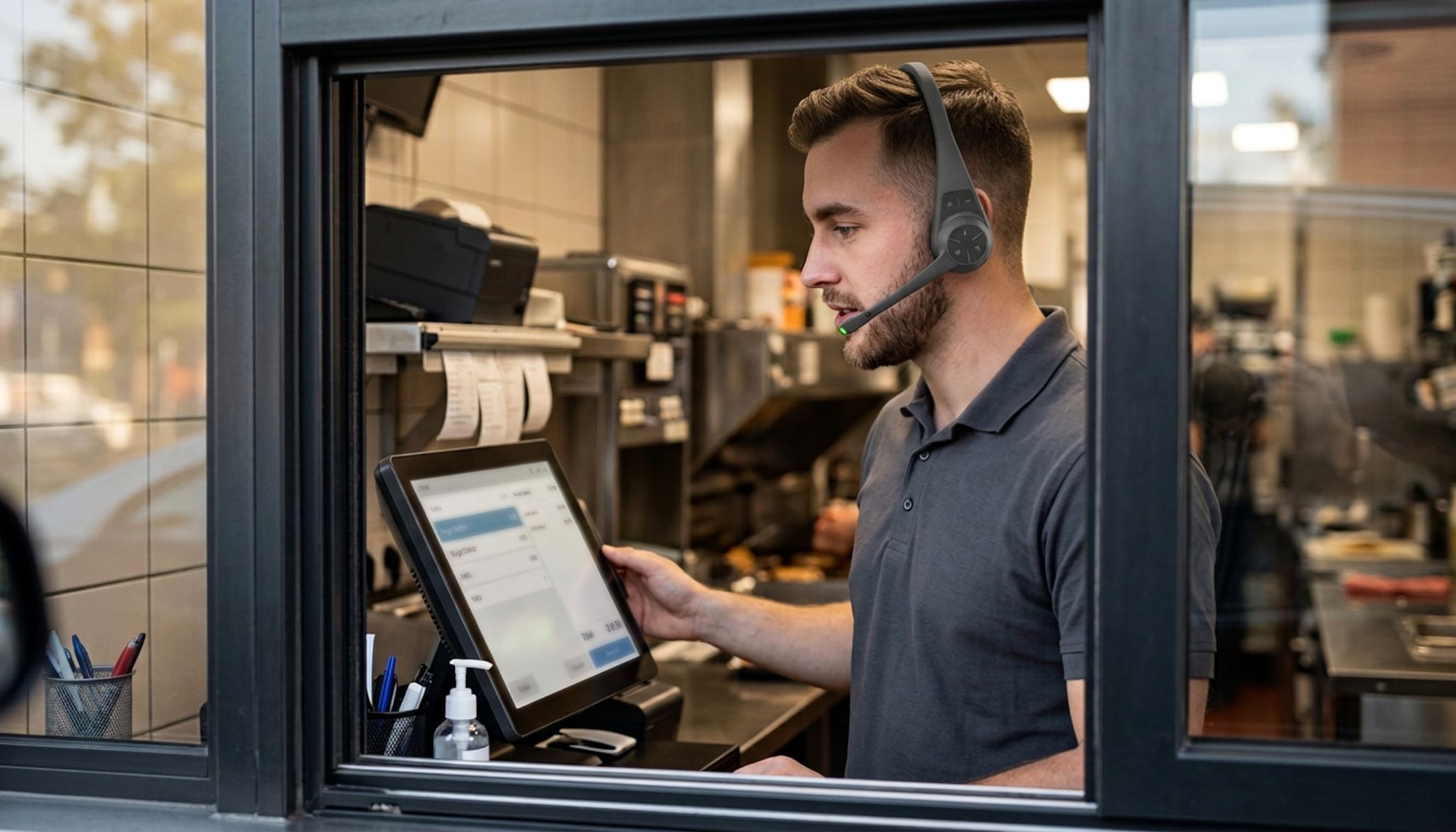
AI-powered drive-thru ordering is moving quickly. But before voice AI can understand an order, it needs clear audio and reliable communication infrastructure behind it.
AI can recognise natural language, process menu choices, and take an order in real time.
But every automated drive-thru order still starts in exactly the same place: with a customer speaking at the speaker post.
Before the AI can interpret what they want, it has to hear them.
As automated order taking (AOT) becomes a more practical application of voice AI, QSR operators are understandably asking which platform to choose, what it integrates with and what it could deliver operationally.
But there is another question worth asking:
Is the drive-thru communication system feeding the AI ready to support it?
The Drive-Thru Is Too Valuable for Communication Friction
A recent study of more than 2,000 operators found that 66.4%of QSR revenue comes from the drive-thru, with almost half of respondents generating more than 70% of their revenue through the channel. The same study found that restaurants lose an average of 5.7 cars per day through abandonment.
At that scale, communication friction is not a minor inconvenience. Repeated orders, slower transactions, and abandoned queues can quickly become a commercial problem.
AI-powered ordering has the potential to remove some of that friction. But adding AI does not remove the need for effective communication. It makes the technology supporting that communication even more important.
Voice AIIs Only Part of the Equation
The appetite for AI is clearly there.
Research highlighted by QSR Magazine found that 82% of restaurant executives planned to increase their AI investment in the following fiscal year.
Automated order taking is one practical application, allowing AI to handle a repetitive part of the customer journey while restaurant teams remain available to focus elsewhere and step in when needed.
But choosing the right AI platform is only part of the decision.
Voice AI depends on voice.
If the audio reaching the system is unclear or inconsistent, the technology is already starting at a disadvantage.
That means operators evaluating AOT should also be asking whether their drive-thru headsets and communication infrastructure are capable of supporting it.
Your AI is Only as Good as What It Can Hear
For operators investing in AOT, drive-thru headsets become more than simply a way for crew to communicate. They are part of the infrastructure supporting the AI itself.
This thinking sits behind Quail Digital's partnership with Audivi, combining Quail Digital's high-clarity drive-thru audio technology with Audivi's AI-powered voice ordering software to support automated ordering.
It is a practical example of a wider point: AOT should not be considered in isolation.
The AI, audio and drive-thru communication system need to work together.
Are Your Drive-Thru Headsets Ready for What Comes Next?
AI is moving quickly. The technology operators choose today may not be the technology they want tomorrow.
So, when investing in a drive-thru headset system, there is another question worth asking: is it only solving today's communication requirements, or can it support what comes next?
Introducing AOT should not necessarily mean replacing the communication technology already operating in the drive-thru.
The Pro9 Drive-Thru Headset System supports AI-assisted automated order taking through Quail Digital's P9AI interface, which is back-compatible with existing Pro9 systems. This gives operators a route to introduce cloud-based AOT while retaining their existing Pro9 drive-thru headset infrastructure.
Restaurant teams also remain able to take over conversations when required and move between AI-assisted and standard operation.
Future-readiness is not about predicting exactly where AI will go next. It is about making sure the infrastructure underneath it does not unnecessarily limit where you can go.
AI Still Starts With a Conversation
AI-powered ordering will make the drive-thru more sophisticated. But the fundamental requirement has not changed.
Customers need to be heard. Restaurant teams need to stay connected. And the drive-thru headset system supporting those conversations needs to be ready for the technology being built around it.
So perhaps the question for operators is not simply:
Which AI platform should we choose?
It is also:
Are our drive-thru headsets ready for it?
Because before AI can understand the customer, it has to hear them.


